
01 / 04Where It Comes From
Everything we know about what we sell.
Where it comes from, how it formed, what happens before you see it, and how to tell what you're holding.

We buy directly from the mines and cutters that supply us. Scale changed what we can carry. It didn't change how we choose: we still open the crates ourselves, and we still send back material that looks better in a photograph than it does on a shelf.
About the word “ethical”
- Documented
- Not documented
- 01.1
There is no Kimberley Process for quartz. The Responsible Jewellery Council's 2024 code reaches ruby, sapphire and emerald and stops there. Nothing certifies rose quartz, amethyst, selenite or fluorite end to end, and anyone offering you a logo for it is selling you a logo.
- 01.2
Roughly eighty percent of the world's colored stone comes out of artisanal and small-scale mining, the part of this industry with the least paperwork and the most people in it. That is the trade we are in, not a footnote to it.
- 01.3
So we do not ask you to be certified. We ask you to be answerable: who dug it, who sold it to you, and whether you can still get a straight answer three links back. Where we cannot get that answer, we say so on the card rather than dressing it up.
If you can shorten that chain
The people who can close that gap stand closer to the mine than we do. If that is you, the buying team reads every one of these.
Talk to the buying team →The one part of the range with real paperwork
Alongside the minerals we carry oddities: fossils and ammonites, bones and taxidermy, framed insects, shells and coral, meteorites and tektites.
Wildlife entering the United States is declared to the US Fish and Wildlife Service and inspected before it clears. We are not the importer. We buy inside the United States, from vendors who can put that paperwork in front of us, and not from vendors who cannot.
One thing we do not carry
Our bundles are blue sage and cedar. That sage is grown and cut in California and Oregon.
You cannot buy white sage smudge bundles or loose leaf from us. That is a decision, not a gap in the range.
White sage grows wild in one place on earth, from Santa Barbara into northern Baja California, where Indigenous communities tended it long before anyone sold it. Demand now outruns the hillsides. The California Native Plant Society puts the illegal take from one preserve above twenty thousand pounds in five years, and poachers pull whole plants rather than cutting, so the stand does not come back.
United Plant Savers lists the species at risk and asks buyers to take cultivated over wild. Many Native people have asked outsiders to leave it alone. Saying no costs us a shelf of something that sells, and it is an easy call.
We do carry incense and oils made with white sage. The line is at the harvested plant, which is what a bundle and loose leaf are.
Both figures above, checkable: California Native Plant Society, United Plant Savers.


02 / 04How It Forms
The rock is 134 million years old. The crystal inside it is not.
Almost every amethyst cathedral in almost every American mall came out of the same lava flow in southern Brazil. This is what happened to it.

- 02.1
A bubble in cooling lava
A flood of basalt buried what is now southern Brazil, well over a million cubic kilometers of it. As the lava cooled, trapped gas left cavities behind. Empty rooms inside solid rock.
- 02.2
Then, much later, water
The cavity sat empty for a very long time. Eventually groundwater carrying dissolved silica worked up through the flow from the aquifer beneath and began filling those rooms from the walls inward.
- 02.3
About as hot as a fresh pot of coffee
Not fire, which is what almost everyone assumes. The evidence puts amethyst growth between roughly 50 and 120 °C, about 120 to 250 °F, and most likely around 80 to 90. Not a furnace, and unimaginably slower.
- 02.4
In this order, every time
Green celadonite against the basalt first. Then banded agate. Then colorless quartz. Then, last and innermost, the amethyst. Cut a geode anywhere in the district and the sequence is the same, because the same water did the same thing.
- 02.5
One flow, twenty kilometers
The source is not a country. It's a single, nearly flat flow forty to fifty meters thick, along a twenty-kilometer strip of hills at Ametista do Sul, Rio Grande do Sul. The mines have names: Salles, Célio, Testa, Trock, Narciso, Mioto, Zanon.
- 02.6
One eruption, four names
The same lava province is called Serra Geral in Brazil, Arapey in Uruguay, Alto Paraná in Paraguay and Posadas in Argentina. Artigas material from the Uruguayan side runs a deeper violet, with a thicker agate lining and shorter points.
And what we can't tell you
We can name the district for most of our amethyst and the mine for some of it. We can't do that for everything in the building, and we're not going to pretend otherwise.
03 / 04On Our Floor
Ask what a stone is. Ask what it's for. Both are fair questions.
How the shelves are sorted, and what the person beside them knows.

Most shops sort by mineral and stop there. We sort the same stock again five more ways. The rock doesn't change. The way in does.
- 01
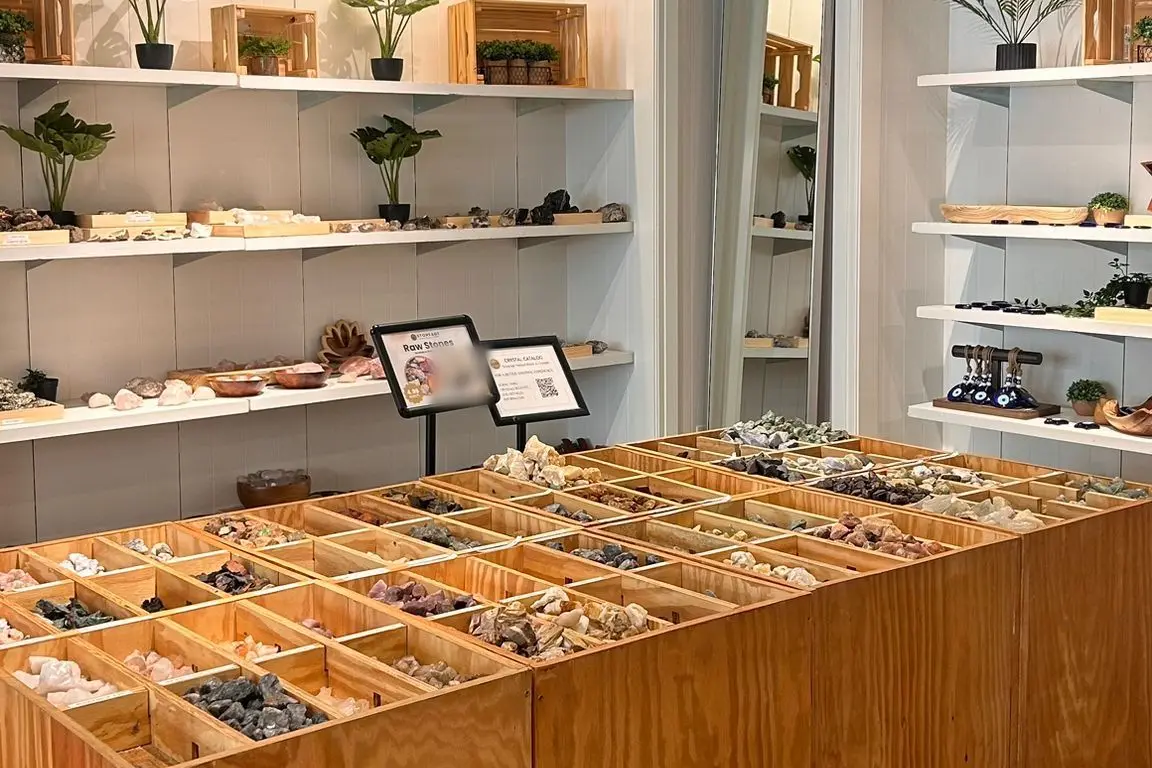
Nobody Corrects You
Collectors, practitioners, and people who wandered in off the concourse all get left alone until they want a hand. Come because your mother's birthstone is garnet. That's reason enough.
- 02
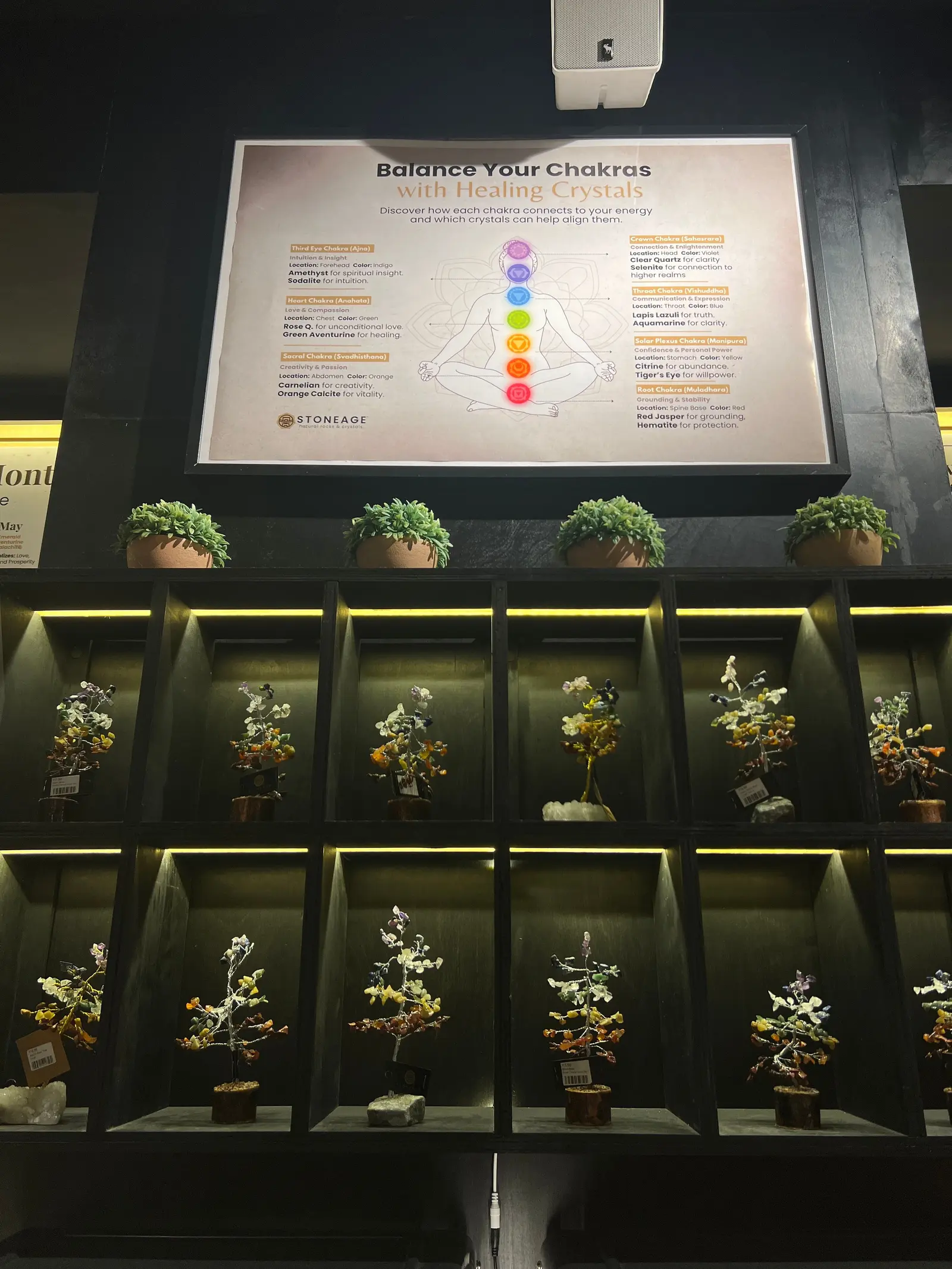
Somebody on the Floor Knows
Every store has staff who learn both halves. The geology is trainable, so we train it. The lore came long before this company and isn't ours to edit.


How we label a specimen
The labels don't change from one stone to the next. That's what makes an empty row visible.
Formula and chakra on one card. Neither is a footnote.
Amethyst
- Species
- Quartz, variety amethyst
- Formula
- SiO₂, colored by trace iron and irradiation
- Locality
- Ametista do Sul, Rio Grande do Sul, Brazil
- Host rock
- Serra Geral basalt, Paraná flood province
- Host age
- ≈134 million years
- Treatment
- None
Properties
- Qualities
- Calm · Intuition · Clarity
- Benefits
- Deepens meditation · Sharpens intuition · Steadies focus
- Zodiac
- Pisces · Aquarius
- Chakra
- Crown
Labradorite
- Species
- Plagioclase feldspar, variety labradorite
- Formula
- (Ca,Na)(Al,Si)₄O₈
- Locality
- Madagascar. Region not confirmed.
- Host rock
- Not established for our lots
- Host age
- Not established for our lots
- Treatment
- Cut and polished. No dye, no coating.
Properties
- Qualities
- Transformation · Intuition · Protection
- Benefits
- Strengthens intuition · Steadies you through change · Shields your energy
- Zodiac
- Leo · Scorpio
- Chakra
- Third eye
Selenite
- Species
- Gypsum, variety selenite
- Formula
- CaSO₄·2H₂O
- Locality
- Morocco. Region not confirmed.
- Host rock
- Evaporite deposit
- Host age
- Not established for our lots
- Treatment
- Cut and shaped. No dye, no coating.
Properties
- Qualities
- Clarity · Cleansing · Peace
- Benefits
- Clears stagnant energy · Cleanses other stones · Brings calm to a room
- Zodiac
- Taurus · Cancer
- Chakra
- Crown
Our customers put it better than we can.
1,168 Google reviews across every store, averaging 4.8 stars. We'd rather you read those than take our word for it.
- 4.8★Buford
- 4.9★Kennesaw
- 4.5★Winston-Salem
- 4.6★Concord
- 4.7★Fayetteville
- 4.9★Jacksonville
- 4.7★Altamonte Springs
04 / 04Real or Fake
How to tell what a crystal is
People ask us this every day, in every store, and the answer isn't a secret. Here's how to tell glass from quartz and dyed from natural, whether or not you buy from us.

Most citrine started life as amethyst
Natural citrine is rare. Most of the citrine in American retail is amethyst that was heated until it turned gold, and the shape gives it away. Baked pieces are usually geode points, with a white or milky base under a burnt orange top. Natural citrine runs paler, smokier, and more even. Both are quartz and neither one's fake. Only one card is honest, and it's the one that says heated.
Opalite never came out of the ground
It's man-made opalescent glass: a pretty material with a milky blue glow, and there's nothing wrong with owning some. There is something wrong with paying opal money for it, or being told it's a stone. If the price of an opal seems impossible, believe the price.
Goldstone is glass. Beautiful, but not a mineral.
Copper crystals grown in molten glass, a technique credited to Venetian glassmakers centuries ago. Nobody digs goldstone up. Sold as what it is, it's a lovely object with real history in it. Sold as a mineral, it's a lie with sparkles in it.
If you pay for turquoise, get turquoise
Howlite is a soft white mineral veined in gray, and it takes dye beautifully. Dyed blue, it's the most common turquoise stand-in there is. Look close: dye sits darker in the cracks and veins, exactly where a dip would leave it.
Candy colors are almost always dye
Agate takes dye so well that the neon blue, pink, and purple slices sold everywhere are almost never those colors on their own. A dyed slice sold as dyed is fine. The saturated rainbow sold as natural is the problem.
Glass has bubbles. Quartz has cold.
Three checks anyone can run without equipment. Round bubbles inside a clear sphere or point mean glass, every time: quartz carries veils, phantoms, and wisps, never neat round bubbles. Real quartz is slow to warm, so hold it to your cheek and it stays cool longer than glass. And look through clear quartz at a printed line. At the right angle the line doubles, because quartz splits light in two and glass can't.
Moldavite is matte, sculpted, and often faked
The real thing is natural glass thrown out by a meteorite impact. The fakes are molded bottle glass: shiny, wet-looking, sometimes with a visible seam. Real moldavite is also never cheap, and a bargain is the loudest tell there is.
Aura quartz is real quartz with a metal coat
The rainbow finish is a thin layer of actual metal, usually titanium or gold, bonded to genuine quartz in a vacuum chamber. That's a treatment, not a fraud, as long as the label says coated.
The one question to ask
Ask what was done to the stone. Anyone who knows will tell you, because a treated stone with an honest label is fine to sell. If they dodge the question, that's your answer.
